दुर्लभं त्रयमेवैतद्देवानुग्रहेतुकम् । मनुष्यत्वे मुमुक्षुत्वे महापुरुषसंश्रयः ।। (वि.चू. ३)
Meaning: These three are indeed rare and are attained only through the grace of God: a human life, a deep yearning for liberation (Mumukshutvam), and the guidance of a great, enlightened master (Mahapurusha).
Wikipedia defines the branches of Science, Physics and Applied Physics, as follows:
- Physics: Physics is a natural science that involves the study of matter and its motion through space and time, along with related concepts such as energy and force.
- Applied Physics: Applied physics is a general term for physics which is intended for a particular technological or practical use.
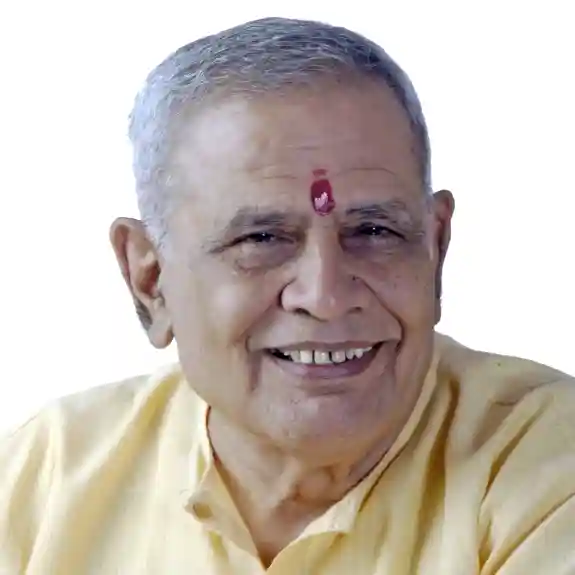
On this same basis, we can contemplate the term ‘Applied Paramartha’. ‘Parama’ means the ultimate or highest, and ‘Artha’ means that which is to be attained. Therefore, Paramartha is the highest goal to be achieved in a human life – the union of the Jiva (individual self) with Brahman (the ultimate reality). The declared motto of Paramartha is ‘the complete removal of all sorrows along with their cause, and the attainment of supreme and everlasting bliss (Paramananda)’. This makes sense as a goal and as a philosophy but how can a spiritual seeker apply this to their daily life (technological) and the spiritual practice (Sadhana)? How do we turn this philosophy into a practical living experience? The answer to this question is ‘Applied Paramartha’. And the 21st-century, modern-day saint who presents this concept so skillfully, precisely, effectively, and most importantly, through his own direct experience, is P. P. Shrikrishna Dattatreya Deshmukh, fondly called as Dr. Kaka.
Regarding applied physics, Wikipedia further states “Applied’ is distinguished from ‘pure’ by a subtle combination of factors such as the motivation and attitude of researchers….” In exactly the same way, the philosophy (pure) that the science of Paramartha presents to us in the form of the Upanishads must be converted into practice (Sadhana); this transformation is a matter of motivation and attitude. Without this orientation towards practice, the study of Paramartha can remain as merely bookish knowledge and its culmination can be in Shastra-vasana (scriptural obsession). It is in this context that Saint Dnyaneshwar says the Bhagavad Gita:
सास्त्रासि बोलाचे नव्हे हे शास्त्र । पे सेसार जिणेते हे शस्त्र । आत्मा अकातरिते मत्र । आळोट इरुडे ॥ (ज्ञाने. ९५.५९९)
Meaning: If the scripture is not transformed into a weapon to conquer the enemy of Samsara, it is useless, as it only creates a scholar of words.
To give a modern-day example, Albert Fert and Peter Gruenberg received the Nobel Prize in 2007 for the discovery of Solid State Memory based on GMR (Giant Magnetoresistance). How widely is this known? Or how did this actually benefit the common man? But when Steve Jobs, the then head of the world-famous company Apple, used the knowledge of GMR to create world-changing products like the iPhone and iPad and put them in the hands of a common person, that is when that knowledge was truly put to use. One who has the ability not only to grasp knowledge but also to apply it is called a ‘Medhavi’. Such a Medhavi, P.P. Kaka taught seekers the ‘art’ of bringing the theoretical knowledge (Paroksha Dnyan) mentioned in the science of Vedanta down to the level of direct experience (Aparoksha Anubhava)— in other words, he essentially he taught them how to practice ‘Applied Paramartha’. This results in a structured methodology of spirituality —which can be referred to as ‘Sadhanashastra’, (the science of spiritual discipline). P.P. Kaka would often emphasize that such a reflective and thought-based approach to Sadhanashastra greatly supports and complements genuine spiritual pursuit. It is in this context that Samarth Ramdas Swami says, ‘समजले आणि वतले । तेची माग्या पुरुष चले ।’ (Those who have understood and acted upon that understanding are truly the fortunate ones). This then becomes the royal path to attaining the important fourfold qualifications (Sadhana Chatushtaya) because it begins with thought based approach of discernment (Viveka). This article explores how P.P. Kaka imparted the art (‘kala’) of experiencing spirituality as a structured discipline (‘shastra’), illustrated through select representative examples.
Term: Deha (The Body-Mind complex)
Principle (Shastra): Aham Brahmasmi—I am Brahman, not the body.
Application (P.P. Kaka): “That which is ‘mine’ is not ‘me'”.
While the scriptures lay out the philosophy, it is the saints who guide us on how to truly live and experience it. This is where saints like Dr. Kaka step in to support the seeker, explaining in simple terms: if something is ‘mine’, then how can it be ‘me’? Starting with external objects, he guides the seeker’s attention to ‘my mind’, ‘my intellect’, and ‘my Prana’ (life force). He explains how it is the “I” that has endowed all these inert objects with consciousness. He teaches the technique of how one can talk to one’s own mind and intellect, and as a result, makes one realize how to gently become detached from them. From this, the seeker gradually begins to understand that if this detachment can be maintained, it is possible to remain unaffected even by the fundamental tendencies of the mind — such as pleasure and pain. This leads to the development of witness-consciousness (Sakshi-bhava). Here too, Dr. Kaka brings ‘Applied Paramartha’ to the seeker’s attention by explaining that the state of being a witness (Sakshi-bhava) is a form of ‘spiritual auto-suggestion’, thereby reinforcing the principle of Applied Paramartha. It is a practice of gently and repeatedly reminding yourself of your true nature. For example: “I am not this thought; I am the witness of this thought.” By reframing it this way, it becomes an accessible, applicable method rather than a mysterious concept. Ultimately, the seeker often doesn’t even realize when this very path of spiritual practice gradually leads them to the scriptural goal of ‘Aham Brahmasmi’ — ‘I am Brahman’. In the end, since this is simply the realization of what is already ever-attained (our own nature), there is no place for restlessness, craving, or the anxious expectation of some new experience.
The spiritual path is not about gaining something new, but about removing the layers of ignorance that obscure the truth of who you already are.
Term: Tapascharya (Austerity)
Principle (Shastra): God cannot be realized without Tapascharya.
Application (P.P. Kaka): “A life dedicated to a goal is called Tapascharya.”
The word ‘Tapascharya’ often brings to mind an image of sages meditating for thousands of years in the Himalayas. We quickly conclude that such austerity is not possible for us and fail to recognize the responsibility and rigor that a spiritual pursuit demands. P. P. Kaka reveals the deeper meaning behind this concept and gives a new life to it for the 21st-century seeker by defining it as ‘a dedicated life’. Just as a top athlete, artist, or scientist, once their life’s goal is fixed, lives a life dedicated to that goal and renounces everything that is unfavorable to it, in the same spirit, a true seeker — one whose goal is Moksha — must dedicate their entire life to spiritual realization. To renounce the non-essential and willingly endure the heat of inner discipline for that purpose, is what we call Tapascharya — the sacred austerity. To the extent that the mind is attached to the body — that is, the stronger the illusion of bodily identity (dehatma-bhava) — to that same extent, the body must be subjected to discipline for the purification of the mind. By using modern-day examples, he teaches how to apply spiritual principles in real life — and through that, cultivates the seeker’s motivation and attitude towards the higher goal. He brings clarity even to the abstract notion of ‘God realization’ — showing that God is, in truth, the pure light of inner awakening, the radiance of the Self. The word “Deva” (God) is derived from the Sanskrit root “Div”, which means “to shine”, “to illuminate”. Therefore, ‘realizing God’ does not refer to some external event, but to an inner realization — a moment of inner illumination. It is in this light that one recalls the profound saying of Samarth Ramdas Swami: ‘पहावे आत्मयासी आपण ।’ — “One must come to see oneself as one truly is.” And see how this transforms the idea of Tapascharya — it is no longer a remote or esoteric practice, but something intimately connected to daily life. It becomes a sincere effort to turn inward, to purify, to illuminate oneself.
Term: Sadhana (Spiritual Practice)
Principle (Shastra): ‘जे एकाची लीला तळे । सर्वभावे मज भजले । तया ऐलिया खडी सरले । मायाजळ ।’ (A verse by Sant Dnyaneshwar Maharaj which means: “Those who have, wholeheartedly, taken refuge in Me and worshipped Me, for them, the ocean of Maya has ended even while they are on this shore.”)
Application (P.P. Kaka): Not performing Sadhana while living daily life, but allowing daily life to unfold within the stream of constant Sadhana (spiritual practice).
According to the conventional idea of Sadhana, most people believe their spiritual responsibility is fulfilled by practicing for half an hour in the morning and evening. Thus, P.P. Kaka emphasizes the principle of ‘daily life within Sadhana’, suggesting a radical transformation in the seeker’s way of living. He teaches the art of aligning one’s life, within existing circumstances, in a manner conducive to spiritual growth. By sharing the very methods he has personally practiced, he inspires enthusiasm and confidence in the seeker. He teaches the ‘application’ of Sant Dnyaneshwar Maharaj’s words, ‘सर्वभावे मज भजले’ (worshipped me wholeheartedly), which is God’s command in the Bhagwad Gita. He places the master key of wholehearted worship of God in the seeker’s hands by explaining that every action (karma) performed by the Jiva each moment should be done according to Ishwara’s command, in communion with Him, by dedicating the fruits of the action to Him, and with the sole purpose of attaining Him. The spiritual path that Dr. Kaka advocates passes through the domains of Dnyan (Knowledge), Bhakti (Devotion), and Karma (Action). He advises adopting whatever is supportive & conducive to Sadhana from all three paths. If one is unable to practice pure, emotion-filled devotion with the love for God like Saints Meera Bai or Namdev, he suggests the path of Dnyan-lakshana Bhakti (devotion through knowledge). He gives the seeker a direct experience of Sant Tukaram Maharaj’s saying, ‘साहे ओझें त्यास तेवी इरडे ।’ (“Give only that much burden which one can bear”), by taking into consideration the seeker’s past merits (from earlier births), present capabilities, natural disposition, and surrounding circumstances. He states that the path of mere knowledge (Dnyan Marga) has the danger of becoming an intellectual exercise and the subsequent activation of ego; the path of mere devotion (Bhakti Marga) devoid of true love has the danger of becoming mechanical, desire-driven, and lacking in scriptural inquiry; and the path of action (Karma Marga) has the danger of doership, leading to endless action and mistaking mere activity as spirituality.
Term: Maya (Illusion)
Principle (Shastra): Swashraya (Dependant on Brahman), Prakriti (Primordial Nature), Pradhan (The Unmanifest Cause), Shakti (Inherent power of Ishwara), Avidya (Ignorance/Nescience), Swa Vishaya (Makes Brahman a ‘subject’ of attainment), SwaNirvahak (Provides a path to know Brahman), ParaNirvahak (Sustains the world), Pratitimatra Sattavan (Having mere empirical existence & not spiritual), Badhayogya (Subject to sublation), SatVilakshan (Different from spiritual reality), AsatVilakshan (Different from unreality; empirical), Anirvachaniya (Inexplicable), NaamRupatmak (Characterized by name and form), Pravahrupane Nitya (Relatively eternal as a flow).
Application (P.P. Kaka): Kama Maya (desire), Krodha Maya (anger), Lobha Maya (greed), Bhaya Maya (fear), Dambha Maya (pretension), Matsar Maya (jealousy), Manorajya Maya (daydreaming)…..
‘काय क्षेप लोभ । नसे तुष्या माया । गावा गुण । तवा विठ्ठेलाचे?’
Based on this Abhanga of Sant Tukaram Maharaj, Dr. Kaka gives concrete forms to the abstract concept of ‘Maya’ by identifying it with desire, anger, greed, jealousy etc., bringing the concept within the grasp of the common seeker. He teaches a simple technique to recognize subtle nature of Maya and its influence: whenever we consider ourselves happy or unhappy, we should understand that we are under the influence of Maya. Dr. Kaka offers a clear and scripturally grounded method to dispel the powerful Maya formed by intense desires and anger inherent in the living being.
Kama (Desire): The happiness that the living being experiences from objects is actually the true bliss of the Self. It manifests only when the mind, intellect, memory, and ego—all the instruments of experience —are calm during the enjoyment of those objects. In reality the joy comes not from the fulfillment of the desire, but from the cessation of the desire.
विषयेभिभिलाषोऽस्य तदिक्षोपरमे सति । अंतर्मुखमनुवलाऽऽनन्दः प्रतिबिंबति ।। (पंचदशी ११.८६)
Meaning: “When the objects of desire have been obtained and, as a result, the desire for them ceases, the bliss [of the Self] is reflected in the inward-turned mind.”
Krodha (Anger): When adverse events occur, the individual naturally experiences anger. However, the fundamental nature of the world is such that things cannot always conform to my desires, especially since my desires may conflict with those of others. In that case, what about their anger?
Lobha (Greed): According to my Prarabdha Karma, I am going to receive only as much as I am destined to, and only when I am destined to. Whether favorable or unfavorable, Prarabdha is the result of my own past actions (karmas), and this is how the cosmic order, known as the world, operates—through the law of Karma-Vipaka.
Bhaya (Fear): Rather than dwelling on “what will happen” or “how it will happen,”, the true path for a householder lies in wholehearted surrender to God— accepting Prarabdha as part of His divine order, diligently performing one’s duties, and staying anchored in the remembrance of His name (Namsmaran).
In this way, by explaining these ‘methods’ to escape Maya, P.P. Kaka says that the moment Maya manifests or is perceived, if one focuses their attention on the Adhishthana (substratum), one can see through the illusion of Maya. In pointing out the error of granting excessive importance to the events of the waking state, through scriptural insight, P.P. Kaka explains – “‘The world that we see, because it is ever-changing, is therefore Mithya (illusory).'” In Vedanta, the ultimate Truth must be eternal and unchanging. Since the world is in a constant state of flux, it cannot be the ultimate Reality. The Jiva (individual self) who impels the eyes with which we see the world, is also Mayik; the very sense of “I” as a separate individual who is experiencing the world is also a product of Maya. If the object being seen is illusory and the subject who is seeing is also illusory, then the interaction between them—our entire daily experience —is necessarily part of that same illusory framework. After coming out of the intense Jiva-created Maya (Illusion created by our personal ego, hatred attachments) and, by the grace of the Shri Guru, the Ishwara-created Maya (Illusion created by cosmic things such as space and time), the seeker is sure to have the experience of dissolution of the ocean of Maya.
Term: Badha Samadhi
Principle (Shastra): Badha means ‘a firm conviction that the world is unreal’ (dridha-mithyatva-nishchay).
Application (P.P. Kaka): “Engaging with name & form, while abiding in the knowledge of one’s true Self.”
The ‘conduct’ of a Jivanmukta—one who has had a firm, unchanging, and direct experience of the truth expounded by Vedanta—is beautifully summarized by P.P. Kaka in this single sentence. It is as if the ‘considering’ (manije) in the verse ‘जे जे दिदिजे भूते । ते ते मानिजे भगवत ।।’ (“Whatever beings are seen, acknowledge the divinity within them”) has been transformed into ‘being’ (asije)! For the seeker who has very idealistic notions about Badhitanuvritti (transcendance) and about the spiritual path in general, Dr. Kaka explains happiness and sorrow at two levels: ‘a mere ripple’ (Tarang) and a ‘wave’ (Laat). He provides clear guidance and reassurance by explaining how it is natural for a ripple of happiness or sorrow to arise in the mind, making the seeker aware that such natural fluctuations in the form a ripple have a legitimate space on the spiritual path. The ‘ripple’ and ‘wave’ are P.P. Kaka’s simple application of the wise saying, ‘सुखी सेठोया न राहे । दुखी विषादा न भजोवे ।’ (“In happiness, one should not get overjoyed; in sorrow, one should not despair.”) Regarding how to apply this ‘ripple’ and ‘wave’ method to the events that constantly occur in a seeker’s life, Dr. Kaka says to look at the world is Mayik (illusory). However, an event does occur in the world, and if that event feels real to us, then it’s safe to assume that the world still feels real to us. Whether an event appears real or not can be judged by the reaction it evokes in the mind. If the reaction is intense, it means the event was perceived as real — like a wave. If the event is not felt to be real, the intensity diminishes (a ripple), and when the intensity is low, it helps to keep the mind continuously fixed on the divine. The seeker then becomes a master of the very precious practice of Anusandhan (unbroken remembrance).
Term: Atman
Principle (Shastra): Absolute Existence that is independent of objects is called Sat. Pure Consciousness that is independent of the known is called Chit. Absolute Bliss that is independent of sensory experience is called Ananda.
Application (P.P. Kaka):
- Sat (Eternal existence): Even when the body was not, I am; Even when the body is, I am; Even when the body will not be, I still am.
- Chit (Pure Consciousness): The pure knowledge which is beyond subjective and objective knowledge.
- Ananda (Bliss): The one who constantly needs to become happy is truly the unhappy one. The one who is bliss itself and therefore no longer strives again and again to be happy, is the truly blissful one.
While explaining the principle of the Atman or Brahman and its direct relationship (true nature) with me (i.e. Jiva, the individual self), P.P. Kaka frames Truth as that which is timeless, expressing it in the language of ‘is-ness’. He explains in simple terms the scriptural analysis of why Saint Tukaram addressed Vitthala three times as, ‘Truth you are, Truth you are, Truth you are, O Vitthala’. And, instead of practicing spirituality from a third-person point of view (‘That Atman is Truth, that world is Mithya’), he reminds the seeker of their responsibility by telling them to practice spirituality from the first-person view: ‘That, I am’ (Sah Aham or So’ham). He elucidates the ladder from the relative to the absolute by explaining the subtle difference between ‘becoming happy’ (sukhi) and ‘being the source of that happiness, bliss itself’ (Sukharoopata). He explains the steps of that ladder as: ‘I need to be happy -> I am happy -> I am happiness-personified -> the state of bliss’.
While explaining the direct application of “Chit” (Pure Consciousness), P.P. Kaka distinguishes between knowledge that “happens” (is produced) and knowledge that simply “is” (self-existent). He then shows — with relatable examples — how we are habituated over lifetimes to adulterated, triputi-based (triad) knowledge, making it difficult for us to grasp the nature of pure, non-dual knowledge. In modern terminology, P.P. Kaka categorizes practical knowledge into Subjective and Objective, and then shows how Self-knowledge (Atma-Dnyan) fits into neither category. Thus, he teaches the seeker not to pursue such knowledge beyond necessity, and in doing so, provides a subtle application for spiritual practice — without rejecting worldly engagement.
Conclusion
The examples above make P.P. Kaka’s ‘Applied Paramartha’ very clear. Through his teachings, a seeker receives excellent guidance on how to develop and refine their own thinking process. The obscurity of spiritual concepts vanishes, the path of Sadhana (spiritual practice) becomes as clear as sunlight, and in P.P. Kaka’s own words, the seeker’s Paramartha becomes SMART (Specific, Measurable, Achievable, Realistic, and Time-bound). Thus, through such Sadhana-centered spirituality or applied Paramarth, the seeker becomes blissful by nature, lives joyfully, and even departs from the world and the body in that very bliss — such is the loving guidance of the bliss-yogi, P.P. Kaka. Apart from this, there is nothing more to be gained through spirituality; and it is precisely for this — and only this — that the science of spirituality exists, reminds P.P. Kaka with the help of Adi Shankaracharya’s words –
अविज्ञाते परे तत्त्वे शास्त्राधीतिस्तु निष्फला । विज्ञातेऽपि परे तत्त्वे शास्त्राधीतिस्तु निष्फला ॥ (वि.चू. ६१)
Meaning: If the realization of Brahm does not occur, then study of Shastra (scriptures, practice etc.) is futile; and once it is realized, the Shastra itself becomes redundant.
This blossom of reflection is offered at the lotus feet of the Sadguru, in deep reverence.
शब्द्ज्ञाने पारंगत । ब्रह्मानंदे सदा डुल्लतु । शिष्य प्रबोधनी समर्थ । यथा उत्तिं निजभावे ॥
Meaning: The Guru is a master of scriptural knowledge, is always immersed in the bliss of Brahman, is powerful in awakening disciples, and teaches authentically from their own natural state of being as is appropriate.
।। श्रीसद्गुरुनाथ महाराज कि जय ।।