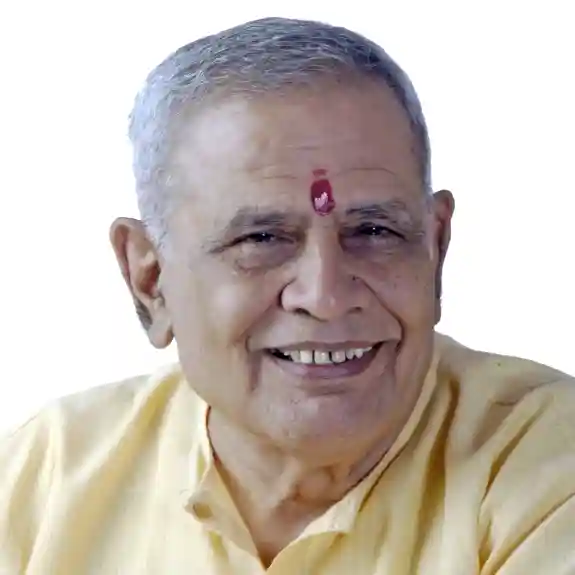
Sraddheya Sri. Prakash Mule
When we observe life on Earth, we find that human beings are superior to all other living creatures. Their superiority is established through two extraordinary powers bestowed by the Supreme Lord: First, the supreme Lord has given humans the power to discern between the real and the unreal (Sārasāra-viveka). Second, they have received the gift of articulate speech (Vaikhārī Vāṇi).
Humanity has also been granted the free will to employ these two powers. Some people have used these powers wisely, for their spiritual progress and attained eternal bliss. This attainment is called attaining Śreyas—the path of ultimate spiritual well-being and the path of liberation. However, most people have used this freedom and powers to attain Preyas—the attainment of fleeting, worldly pleasures. In the Kaṭhopaniṣad, Yamadeva tells Nachiketa that those who choose Śreyas after obtaining human birth are truly wise (intelligent), while those who lack this wisdom (dull-minded) choose Preyas. Thus, God’s message is clearly imparted through Yamadeva in the Kaṭhopaniṣad — that the true purpose of human life lies in the attainment of Śreyas. The following śruti proclaims:
‘श्रेयो हि धीरोऽभि प्रेयसो वृणीते । प्रेयो मन्दो योगक्षेमाद् वृणीते ।।’ (Kaṭha. 1.2.2)
Meaning — The wise person chooses the good (Śreyas) over the pleasant (Preyas). The foolish person (dull-minded/slow-witted) chooses the pleasant, and is concerned only with personal gain (yoga) and preservation (kṣema).
In essence, the wise use both powers—discrimination and speech—for attaining the highest goal. Discrimination (Sārasāra-viveka) is the ability to distinguish the Self from the non-Self. Just as a swan can separate milk from water and drink only the milk, so too the wise, through divine grace and Sadguru’s guidance, separate the Self (Ātma Tattva) from the non-Self (Anātma Tattva). By accepting the Self, they attain eternal bliss and reject what is transient and sorrowful. In short, Śreyas means realizing the Self (Ātma-Sakṣātkāra), while Preyas means wasting one’s life pursuing fleeting worldly pleasures.
The true measure of human excellence does not lie in material progress, but in what one has done for Self-realization. Building grand structures, making scientific discoveries, and improving human comfort are praiseworthy, yet these only increase the means of comfort, not happiness itself—as we all experience. Yet, from such efforts, only the means of comfort have increased, not true happiness — this is an experience we all share.
On the contrary, thinkers realize that as the accumulation of means of comfort increases, one ends up wasting precious time in protecting and maintaining those very possessions. In the Bhagavad Gītā, the Lord calls the path of Śreyas the “most secret science” (गुह्यतमं शास्त्र). He declares that the one who understands it becomes truly wise and fulfilled (कृतकृत्यश्च). Therefore, the Vedās command that every human being must acquire this knowledge. The Kena Upaniṣad warns that to die without realizing the Self is the greatest loss:
‘इह चेदवेदीदथ सत्यमस्ति न चेदिहावेदीन्महती विनष्टिः।’ (Kena 2.5)
“If one knows It here, then the truth is attained; if not, great destruction ensues.” The meaning is clear: To be blessed with a human birth — so rare and precious — and yet depart without Self-realization is the greatest tragedy.
So, what kind of knowledge enables one to live the life of Śreyas? That knowledge is Advaita Tattva Jñāna—the knowledge of non-duality. The scriptures refer to it as Ātma-Sakṣātkāra (Self-realization), Adhyātma-Jñāna (spiritual knowledge), Brahmanubhava (the experience of Brahman), Svarūpa-jñāna (knowledge of one’s true nature), and so on.
The Vedās, sages, saints, and philosophers have all expounded this path of Advaita in this article. The lineage of this non-dual knowledge traces back to the very beginning of creation. It teaches that the same Self (Ātma Tattva) exists in all beings (living and non-living) and manifests as the diversity of the universe.
The Supreme Lord Nārāyaṇa first revealed this Advaita Tattva Jñāna to Brahma. In the Bhāgavata Purāṇa, Nārāyaṇa instructs:
‘अन्वयव्यतिरेकाभ्यां यत् स्यात् सर्वत्र सर्वदा ।।’ (2.9.35)
According to Advaita Tattva Jñāna through the process of agreement and difference (Anvaya-Vyatireka), Anvaya (inclusion/presence) and Vyatireka (exclusion/absence), realize that Ātman alone remains before creation and after dissolution, and also pervades existence during creation. ‘योऽवशिष्येत सोऽस्म्यहम् ।’ (Bhāgavata 2.9.32) Advaita philosophy teaches that the Ātman remains ever-present, even during the period when the universe is being sustained. After meditating for a thousand divine years, Brahma attained Self-realization and thereby gained the power of creation (creating the universe).
Brahma then passed this knowledge successively to Sage Vasiṣṭha, then to Śakti, to Parāśara, to Bādarāyaṇa Vyāsa, to Śukācārya, to Gauḍapādācārya, to Govinda Yati, and then to Adi Śaṅkarācārya. Thus, this sacred lineage of Advaita Tattva Jñāna continues unbroken and is still carried forward by realized Gurus today.
The teaching of Advaita is that throughout the universe, there is only one eternal principle—pure consciousness—and only non-duality is truly experienced (Aparokṣānubhūti). Duality does not exist at all. The Māṇḍūkya Kārikā declares, ‘ज्ञाते द्वैतं न विद्यते।’ (Mā.Kā. 1.18) “In the state of knowledge, duality disappears”. All the sacred texts—the Vedās, Upaniṣads, Brahma Sūtras, and Bhagavad Gītā, and the words of saints—teach and support this Advaita philosophy. The Upaniṣads consistently affirm the same truth:
‘सर्वं खल्विदं ब्रह्म ।’ (Chāndogya 3.14.1) “All this is indeed Brahman”, ‘एकमेवाद्वितीयम् ।’ (Chāndogya 6.2.1), “One alone, without a second”, ‘ब्रह्मैवेदं सर्वम् ।’ (Nṛsi. 7) “Brahman alone is all this”, ‘इदं सर्वं यदयमात्मा ।’ (Bṛhadāraṇyaka 2.4.6, 4.5.7) “This Ātman is all that exists”, ‘नेह नानास्ति किंचन ।’ (Kaṭha. 2.1.10-11) “There is no diversity here”. Thus, the scriptures declare that everything is Brahman. It is one and without a second; Brahman alone is everything. Whatever exists here is all the Ātman. Thus, the scriptures declare the complete absence of duality—only Brahman, only the Ātman exists here. This is the essence of Advaita.
Gauḍapādācārya, the Guru of Adi Shankaracharya’s Guru, expounded this truth to the world through the Māṇḍūkya Kārikā, describing the doctrine of Ajātavāda—the view that, in reality, nothing was ever created. Though this is true in essence, ordinary people experience only duality, and only a few enlightened beings realize non-duality: ‘मनुष्याणां सहस्रेषु… ।’ (Gītā 7.3) “Among thousands of men, scarcely one strives and attains Me.”
For this reason, most people accept Advaita as a theory in faith but doubt its reality. To them, Advaita seems difficult to grasp. Hence, apart from the eternal Vedic path, schools of thought like Sāṅkhya, Nyāya, Vaiśeṣika, Yoga, and Pūrva Mīmāṃsā accepted dualism. However, Ādi Śaṅkarācārya, through his brilliant reasoning, established that the true essence of the Vedās upholds only non-dualism. Because of this, even though the other five Darśanas were Vedic, their dualistic view could not be established against Śaṅkarācārya’s powerful tarka (logic) and yukti (reasoning). Still, one might ask: if non-duality truly pervades everything, why do people not perceive it? Instead, why do they experience duality—self and other? To understand this, one must know what “duality” is. To experience anything as distinct from oneself, other than the awareness “I am”—is to experience duality. The awareness “I am” is the experience of consciousness (Chaitanya). To experience something apart from that—a non-conscious entity—is duality. In technical terms, any experience that appears distinct from the Ātman or different from Brahman is duality.
According to the Advaita principle, if only consciousness pervades everything, then there should be no inert objects (जडवस्तू) at all. Is this true in reality? No. Yet, we do experience both conscious and inert realities. Ādi Śaṅkarācārya resolved this through the concept of Adhyāsa ‘अध्यास (विवर्त)’ (superimposition or illusion of appearance). He demonstrated that only Advaita is real and that no one ever truly experiences duality. He proved this through reasoning and examples, which can be briefly explained as follows.
Consider this simple analogy: with our tongue, we taste sweet, sour, and bitter—all with the same organ. Likewise, in each of us, who is the one who declares “this is conscious” and “that is inert”? The same consciousness perceives both experiences. Dualists might argue that the intellect differentiates between them, but the intellect itself is inert and can apprehend only inert things, as it is of the same nature (Jaḍa). Consciousness alone illumines both, but it cannot perceive materiality as separate from itself. Just as there is no third tongue that declares ‘bitter’ and ‘sweet,’ who is this third entity in us that declares ‘this is conscious’ and ‘that is inert’?
Is it conscious or inert? If you say it is conscious, we face the same problem of recognizing only what is similar in nature. The sun cannot perceive darkness. Darkness cannot perceive the sun. The inert can never know consciousness. Consciousness can never know inertness. Between these two, whatever that third entity is, it must be one. If it is one, then non-duality is established.
Even if we briefly assume that this third entity within us is ‘inert,’ non-duality is still proven. However, no one has ever experienced an inert object gaining Jñāna. Jñāna is the nature of consciousness, not of inert matter. Then how do we explain our claim that we experience inert objects?
To explain precisely this, Ācārya wrote his commentary on Adhyāsa (superimposition). Dualists are not convinced by this reasoning. They are also unwilling to accept that everything is merely inert. Therefore, they are forced to superimpose consciousness onto inert matter and inert matter onto consciousness (treating inert nature as independently real). Thus, Śaṅkarācārya concludes that duality is never truly experienced — ‘अन्यस्मिन् अन्यारोपः’ only Advaita is ever perceived. The so-called experience of duality is merely the illusion caused by Adhyāsa (mutual superimposition of the real and the unreal). This is why no one has ever actually experienced duality. Everyone experiences only non-duality continuously, but talks about duality with their words. Only when Self-knowledge dawns does this truth become evident. Until that happens, philosophers and skeptics keep arguing with each other.
The Aitareya Upaniṣad states this same principle of non-duality in its very first verse: ‘ॐ आत्मा वा इदमेक एवाग्र आसीत् ।’ (Aitareya 1.1) ‘Om, Ātman alone existed in the beginning’. Before creation, only the Self-consciousness existed—one and alone. This mantra teaches that the cause of the world’s creation is conscious, and that cause itself is one (non-dual). Gauḍapāda states:
‘मायामात्रमिदं द्वैतमद्वैतं परमार्थतः ।’ (Mā.Kā. 1.17) “This duality is mere illusion; non-duality alone is the ultimate reality.” The Brihadaranyaka Upaniṣad explicitly negates duality: ‘न तु तद्वितीयमस्ति ततोऽन्यद् विभक्तं यत् पश्येत् ।।’ (Bṛhadāraṇyaka 4.3.23) “There is no second entity apart from it”, and further warns, ‘द्वितीयाद्वै भयं भवति ।।’ (Bṛhadāraṇyaka 1.4.2) “From duality arises fear”.
Thus, through scripture (Śruti), reasoning (Yukti), and direct experience (Anubhava) of realized sages, Advaita is firmly established. The realization of this truth destroys all sorrow and grants eternal bliss. Hence, this non-duality (Advaitam) is supremely auspicious. Gauḍapādācārya instructs:
तस्मादेवं विदित्वैनमद्वैते योजयेत्स्मृतिम् । अद्वैतं समनुप्राप्य जडवल्लोकमाचरेत् ।। (Mā.Kā. 2.36)
“Knowing this truth, fix the mind in non-duality; having realized it, move about the world with equanimity.” This subject is vast. Within the limitations of this article, I pray that by Sadguru’s grace, all may realize this Advaita Truth, and I offer this article at the Sadguru’s feet.
॥ Thus, blessing upon all ॥